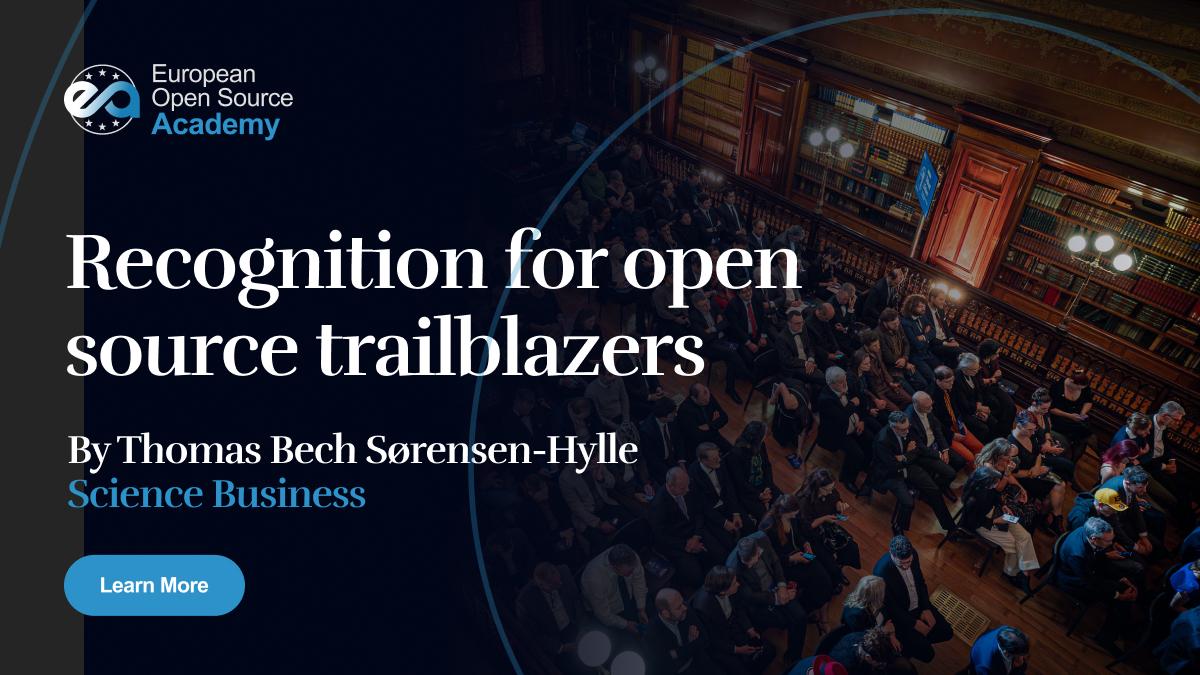
At the second annual European Open Source Awards, Greg Kroah-Hartman received the main prize in recognition of his “outstanding impact” in open source software development, technical leadership and sustained excellence over several decades.

Photo Credits: Trust-IT
“I feel very privileged and honoured that my peers have recognised the work I have done for so long,” Greg Kroah-Hartman, a fellow of the Linux Foundation, told the awards ceremony at the historic Bibliothèque Solvay in Brussels on 29th January. “But it is not just me, there are tens of thousands of developers doing this work,” he added, emphasising long-lasting solutions as a core strength of the open source community. “Writing code once is really easy, making it work for 25 years is a totally different kind of engineering. The open source community is really good at that. It is like maintaining a bridge for 100 years.”
Hosted by the European Open Source Academy and supported by the EU-funded project OSAwards.EU, the ceremony recognised the human stories behind Europe’s digital infrastructure – much of which is based on open source technology – including developers and community leaders whose work sustains everything from cloud computing and AI to healthcare, energy systems, and public services.
Digital engineering requires a steady flow of talent, Kroah-Hartman noted. The next generation has always been important for the Linux kernel developer, who has worked with universities since starting out in the 1990s. “I want students to get involved and always tell them the best way to get a job is to start a project while studying,” he said. “It gives them something to show later and say: ‘I worked on this open source project and I fixed these bugs’, demonstrating you can collaborate and work on existing code base.”
In addition to Kroah-Hartman, the following individuals were honoured for their remarkable contributions to the open source community:
- Advocacy and Awareness category: Jenny Molloy, senior research associate, Shuttleworth Research Fellow, University of Cambridge, GOSH - for ensuring open source is included in the policymaking agenda, and raising awareness of open source technologies.
- Business and Impact category: Frank Karlitschek, CEO and founder of Nextcloud - for paving the way for open source innovation, commercialisation and impact, showcasing that open source is a key component of European digital competitiveness.
- Community Impact category: Roberto Di Cosmo and Stefano Zacchiroli, founders of Software Heritage - for positive impact on the open source ecosystem and advancing the interests of open source collaboration and innovation
- Skills and Education category: Matthew Venn, founder of Tiny Tapeout - for pioneering educational projects and initiatives advancing open source skills, education, knowledge.
Helping Europe pursue digital sovereignty
The European Open Source Awards formed as a key part of the EU Open Source Week, a week-long series of events bringing together a range of stakeholders to recognise outstanding contributions to open source software, hardware and open technologies. Such initiatives highlight open source as an increasingly hot topic, which in recent years has gained more awareness beyond the digital community.
Policymakers are starting to take note, with the European Commission, among others, advocating the use of open source software to foster innovation, security, and digital sovereignty. The European Open Source Awards, which were attended by Thibaut Kleiner, director for future networks in DG Connect and other representatives of the European Commission, Member State Permanent Representatives and MEPs, help to forge political relations and raise awareness in broader terms.

Photo Credits: Trust-IT
“The examples we honour tonight add credibility when we are approached by European lawmakers. Digital sovereignty would simply not be possible without open source software,” noted Amandine Le Pape, head of section at the Open Source Academy. “Without transparency, there is no trust and no control. You want control over where to host your software and the ability to switch vendor or take your data and move it somewhere else.”
Building longevity and sustainability
Transparency and holistic, long-term thinking also resonate with Roberto Di Cosmo and Stefano Zacchiroli. The founders of Software Heritage, which shared the Community Impact prize, are celebrating 10 years of collecting and preserving software in source code form. “Sustainability is a common challenge for all open source initiatives. We need to lay the ground to make sure that the archive is there, not just 10 years from now, but 100-200 years from now,” said Zacchiroli.

Photo Credits: Trust-IT
As a UNESCO-partnered project, Software Heritage underlines open source as a discipline with wide-branching relevance and defies the notion of data as easily replaced or replicated. Standing next to the Bibliothèque Solvay’s ceiling-high shelves of timeworn paper, Zacchiroli stressed digital code’s role to society: “It is really important to have a trace of what is built. If you lose an essential piece of source code, which makes critical society infrastructure work, that is a disaster.”
By celebrating the innovators behind open source technology, the European Open Source Awards aim to highlight what open source is, what it is capable of and why it is important. Over the next 12 months, the Open Source Academy will continue to persuade decision-makers across the continent to recognise the importance of open source, support the people creating these technologies, and invest in sustaining and securing them.
Looking ahead to the third edition, the nomination process will open in 2026, inviting the community to once again put forward their candidates. This collaborative approach ensures that the recognition continues to reflect the voices and values of those it serves, building on the success of this year's event.